Monday, 18 May 2020

P4 - Pitch Ideas to the Client

Final Pitch Powerpoint -


Pitch Prompts -


I created a paper document I could use when presenting my pitch which allowed me to know what the contents of each slide were, since I could not actually view the powerpoint when presenting my pitch. This document helped me navigate my pitch powerpoint and also gave me more information to talk about readily available incase I stumbled my words or had a mind blank during presenting my BBC3 TV series.

Final Pitch Video -


I thought that my final pitch went well, I delivered my pitch in a clear manner and did not stutter or stumble my words throughout my pitch. My mannerism was also professional and I felt like I dealt with the management of having the deliver my pitch digitally well and also the problem of one of my clients dropping out midway through my pitch due to technical problems. I believe I sold my idea well to the client as I gave a clear description of what it was about and how each character would develop, they also liked the genre of a drama mock-umentary which was a positive. I quickly gave a synopsis of my show almost immediately after describing where the origins of the title came from and by the end of my pitch I was confident that I had covered all of the required aspects. The only thing I missed from my pitch was to clearly tell the client what genre my TV show was before elaborating on what the conventions of that genre was. 

I had all my supporting documents ready for the client to view and thought they added to my presentation as it helped the client get a more visual idea of my TV series and the characters that would be in it and a rough idea of what they would look like; also having a poster I believed show cases the rough raw documentary style I would aim to achieve if my TV show event into production, allowed the client to visualise my TV series better. To have improved my overall delivery I would say, I needed to have a more open body language to appear confident when pitching and use more concise terms to get straight to the point instead of 'taking the long way round' to get to the same point. Overall I think I delivered a strong pitch, as I was confident in the powerpoint I made to aid my pitch and the prompt sheet I had in-front of me so I always new what slide the client was on and what to talk about.

Wednesday, 13 May 2020

P2 - Supporting Documents

Character Profiles -


Sticks 'N Stones Poster -


Font -
I chose the font "Wilson Hawk" which had a free download from dafont so I was able to incorporate it into my poster above, and also below.


Pilot Episode Opening Scene Script -


Pilot Episode Opening Scene Storyboard -


Example of Marketing Advertisement on Snapchat -


Detailed Episode Breakdown -


Episode 1 -
In the pilot episode we will be introduced to all the characters and how the group dynamic works, we we all being to see the small traits of characters which will be part of the audience will see turn into their defining characteristics as the show progresses. The pilot episode will also show the main location of the series, this being the school and the day to day routine of the school and how the characters go about their time here.

Episode 2 -
We begin to see a more in-depth look at the characters life at school and they take the documentary team around the school showing them all the ins and outs they’ve found. We are introduced to Cadwell Walkers love interest, Amy Anderson for the first time and also hear about the BOL-X virus for the first time as an over the shoulder comment which the characters do not think about but lays the foundation for the audience.

Episode 3 -
Episode three will be set around pancake day and will remove the characters from the school setting and will show the audience Leo Thomas’s house as they will go there after school to try make pancakes unsuccessfully whilst Cadwell Walker is distracted thinking about Amy Anderson and Ben Boondock causes a disruption to the equilibrium when he breaks Leo Thomas’s Neighbours fence. The treat of the virus becomes greater and the characters have acknowledged it now but just make fun of it.

Episode 4 -
Episode four will be set outside of school on a geography field trip where the set work is to measure soil moisture at a local river. This is the episode where they will find the bag of unknown drugs and decide to take it as they are curious but do not know its danger apart from Harry Williams who tries to convince them not to, there is also the first announced case of the BOL-X virus in the UK with the characters still not taking any care to it.

Episode 5 -
Episode five will take place in school where extra steps to promote self hygiene in order to combat the virus are being taken and we will watch the characters begin to deal with the worry of the virus. They still have possession of the drugs with little knowledge or plan of what to do with them. In this episode we will begin to see Harry Williams snap and lose his responsible side and where this takes him.

Episode 6 -
Episode six will be set outside of school on a weekend as such and will see the characters meet up to dispose of the drugs however Harry Williams tries to prove himself as irresponsible and decides to try some. Miles Elland and Ben Boondock begin to laugh and find it funny, Cadwell Walker is annoyed as he wanted to sell it and Leo Thomas is worried about Harry Williams health, this all makes a lot of noise and a passerby calls the police.

Thursday, 9 April 2020

M2 - Identifying Potential Questions

Practise Pitch Evaluation -


I felt I delivered a good pitch and was confident when delivering the pitch and running through my slides however I could work on using the slides as prompts instead of simply reading off them. I could answer the questions I was asked however I did stutter a little and had to find the write wording to respond to the question so I could improve on this perspective. I also need to understand my own series in more depth so that I can go into detail about how it will evolve and how we will see the characters change throughout my series, to do this I will work on making a more in-depth episode breakdown and a character arc.

Questions I was asked during my practise pitch:

1. By public school do you mean like a fee paying private school?
By public school I am referring to an open state school which does not charge its students to study there.

2. Whats the first disruption, the drugs or the virus?
The first disruption will be the virus as we will hear about this before the drugs, however the first physical disruption will be the drugs as the characters find the drugs before any physical change has been made to their life due to the virus.

3. When you say documentary style, are you going to have the people in it talk directly to the camera as if they have a documentary crew following them around?
I plan to have my characters talk directly into the camera as if it was a person, breaking the 4th wall in production so the the audience feels more connected with the characters rather than just watching strangers on a TV screen.

4. Is the narrator voice one of the characters or more of a disembodied voice?
The narrator is a disembodied voice and we will only ever hear their voice and will never be able to put a face to the voice as it is only to set the scene at the beginning of each episode and to give a light overview of the events within the episode.

5. Is episode one set before the outbreak of Covid-19, as we understood life in January?
Episode one is set before the outbreak of Covid-19 and is meant to set the equilibrium and allow the audience to get to know the characters before any disruptions occur and also for the audience to recognise a disruption as the equilibrium will change.

6. When the characters find the drugs, do they understand what they have taken?
When the characters first take the dugs they do not fully understand what they have taken they just believe it might be a gimmick or a trick, with no thoughts that they have just taken real drugs.

7. Are there any scenes with explicit drug taking within in your show?
There will be no scenes of explicit drug taking as the characters will not know how to take the drugs, we will see them try different methods with no success to actually taking the drugs.

8. Is Harry Williams responsible at the start and his journey is losing this and becoming more corrupt throughout the series?
Harry Williams is responsible throughout the show and his journey to becoming less responsible is not a set change more of a fluid change between responsible and irresponsible depending on the people around him and how they push him into doing things.

9. Does Leo Thomas react badly to jokes about his height?
Leo Thomas does react badly to jokes about his height although he has become use to the clever remarks made about his height and sometimes lets them slide.

10. Explain how the title relates to the story overall and how it relates to the phrase "Sticks and stones may break my bones but words will never hurt me"?
The title relates to the phrase "Sticks and stone will break my bones but words will never hurt me" as I think this is a very teenage way of thinking, with little care and very relaxed in how to approach possible dangerous situations. So I chose the title Sticks and Stones to try relate back to this phrase and represent the attitude of thinking that goes with it.

11. How are the girls represented throughout the TV series, are they represented as friends or simply as eye candy for the audience?
The love interest in my series is represented as eye candy from the love interests perspective but as a friend from the perspective of the rest of the groups, she will also have a strong sense of self worth and be sure make the male characters work for her.

Additional Questions I may be asked?

1. How do the characters finally get rid of the drugs?
2. Do you have an idea of a school you would set it in?
3. Will the character get the love interest?
4. Do you have any ideas on who you would like to narrate?
5. How will you use the soundtrack you have chosen?
6. What cliff hanger will we see at the end of the series?
7. What journey will each character take throughout the series?
8. What its the purpose of your TV series, what do you intend to serve the audience?

Planned Improvements

I will first work on improving my proposal which is the aid to my pitch by adding in some more visual prompts which I can use as a signal to talk about a certain area of my TV series so the presentation of this information appears more fluid and not like I'm reading off a slide.
I will also compress the slides I have and only present essential information and visual images then create some cue cards I can use to prompt myself so that I do not simply present a slide of numbers and words. As I keep working on my TV series I will also gauge more knowledge and understand of where I want my TV series to go so will be able to talk about it confidently without stopping to think and ideally be able to answer questions immediately on the spot.

I will also review the characters I plan to use so that I can try incorporate more diversity into my TV series instead of all the main characters being being White British males, however though this does fit the location demographic as 85.8% of the population in Yorkshire and the Humber are white.

I will also try to understand the storyline for my TV series better so I can fill in holes within my episode breakdown to present an accurate and detailed idea of what will happen in each episode and how the series will progress in terms of disruptions occurring and being fixed, the characters changing and developing as they try to restore the equilibrium and what the final cliff hanger will be.


P3 - Pitch

Practise Pitch Powerpoint -


Practise Pitch Video -


I did not use any prompts or scripts when completing my practise pitch.

Final Pitch Powerpoint - 


Final Pitch Video -

Friday, 27 March 2020

Sunday, 22 March 2020

M1 - Strengths and Weaknesses of Ideas

Idea 1: The Detective
Idea 2: Missing Man
Idea 3: Stick's and Stone's

I conducted a focus group compromised of six individuals who listened to my three ides and then commented on what they though of the idea. The focus group I pitched to consisted of four females and two males all between the ages of 17-18 which is good as this is the target market for my TV Drama; unfortunately I did not find the average social grade of the social group as I thought it was inappropriate to ask and has the chance to upset members of my focus group.

Their initial reactions to my ideas seemed some what positive, they thought that my first idea was interesting although I'm not sure they actually understood the idea to its full extent. Two members of the group seemed to really like my second idea and the rest did not react much, this could have been to them not listening or not liking the idea. My third idea seemed to get the best reaction as they all seemed curious and engaged more when I was explaining my idea to them, which I took as a positive thing, then listing this as my best idea.

SWOT Analyses of Idea 1: The Detective

My first idea, The Detective, is a TV Series where the main protagonist is a detective who is also the murderer and solves his own crimes to get some recognition from the people around him. I thought this was a strong idea as it seemed to me like it had a unique selling point and was an original idea however upon research I found a few other programmes which had the same basic idea. The TV series would fit in with the BBC 3's ethos as it deals with a social issue and the whole programme can be filmed with a small cats I relatively cheap locations. The idea was directly inspired from he primary research I conducted from the BBC 3's target audience with the favourite genre being crime drama.


SWOT Analyses of Idea 2: Missing Man

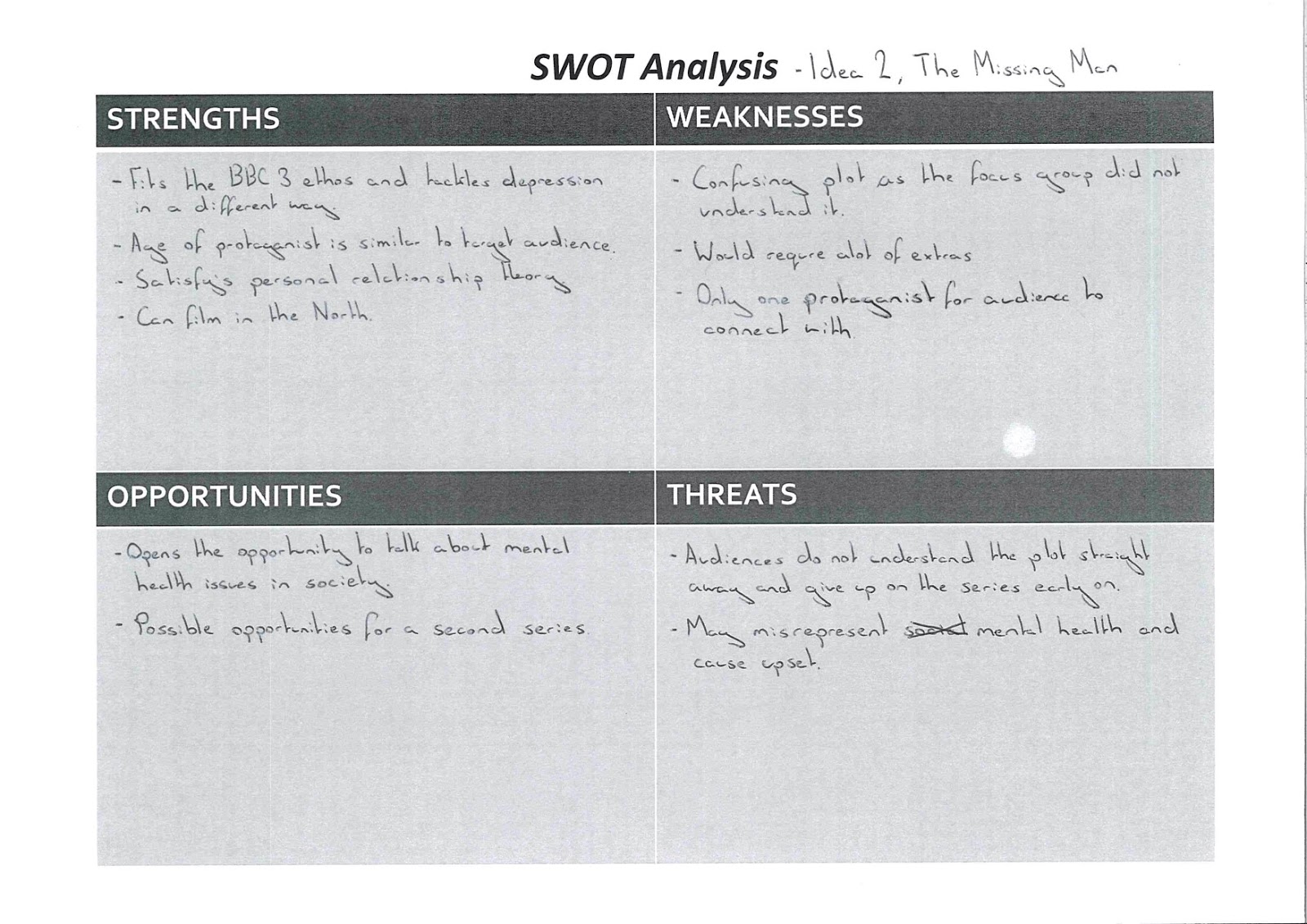
My second idea, Missing Man, is a TV series idea that is based around the social issue of depression and how it can make people feel invisible and if they are not seen, so I took this concept and made it literal so a boy is thought to be missing however people just don't recognise him and don't interact with him, almost as if he was invisible and so he then begins to use this to his advantage and we follow him in doing so. This idea again fits in with the BBC 3's ethos as it tackles a social issue that is prominent in every day life for many people, however when I pitched the idea to the focus group they did not understand the idea very well and were not very interested in the idea so this is a weakness to the idea. If I went forward with this idea I would have to be very careful in the way I portray mental health so I do not upset anyone and the story of the show means that it may be difficult to create a second series as the main plot is already known.

SWOT Analyses of Idea 3: Stick's and Stones


My third TV series idea is for a programme called "Stick's and Stones" and originally it was a comedy docu-drama about a group of teenagers and we follow them about there daily lives and the troubles that they get into, however due to recent events I may change the disruption of equilibrium to a virus breaking out and the teenagers being put on lockdown. This idea is good as it satisfies all three audience needs, escapism, personal identity and personal relationships so hopefully they will be able to connect to the TV programme no matter the reason the audience watches TV. The TV show also allows for a wide range of stories to be told so the audience will not get bored of a possible recurring plot. The TV series however would need a fairly large cast of around 5-6 actors although as its set as a documentary-drama the actors don't need to have lots of experience since it will make the programme more real. The filming technique of a comedy documentary-drama, similar to the programme "This Country" is quite a unique filming technique which can be used to advertise successfully but may also turn audiences away if they do not like this technique. The TV series being quite an open one means they will be time to give the characters depth and allow the audience to connect with the characters they see on screen and open the opportunity for a second or even this series.

Tuesday, 17 March 2020

Unit 1 - Representation

To create an idea for a media product you first have the real life inspiration, which the gets mediated, and then it becomes the final media product. Mediation is simply how you choose to recreate real life to create something interesting for the audiences to watch and by doing this you then re-present this to the audience.

For representation to be meaningful to audiences there needs to be a shared recognition of people, situation, ideas etc. All representations therefore have ideologies behind them.

What sense of the world is it making?
The media creator creates a world where it seems that working class youths are stereotypically violent and go around committing crimes in the new equilibrium they working class youths repel to the stereotype 

What does it imply? Is it typical of the world or deviant?
It implies that young children who live in council estates may be violent and commit crimes.

Who it it speaking to? For whom? To whom?
People who fit into the stereotypes shown in the film, it also shows a new representation of the youths which may change peoples perception of that stereotype which could impact the person real life actions.

What does it represent to us and why? How do we respond to the representation?
It represents stereotypes throughout the movie so that the audience can relate to them and then flips these stereotypes around to give the audience a new perspective on their existing stereotypes.

We often judge a media products realism against our own view of culture, whats "real" can therefore become subjective

Walter Lippmann had a theory that films used stereotypes often as a shorthand way of portraying certain groups, but of course this comes with the risk of misrepresentation people in the media.

Tessa Perkins in contrast to Walter Lippmann said that stereotyping is not a simple process, she identified that some of the many ways that stereotypes are assumed to operate aren't true:
   - They aren't always negative
   - They aren't always about minority groups or those less powerful
   - They are not always false, supported by empirical evidence
   - They are not always rigid and unchanging
Perkins argues that if stereotypes were always so simple then they would not work culturally and over time.

Does Attack the Block contain stereotypes and how are these constructed:

Gang members ( Moses and gang ):
Stereotypes are constructed through language, clothing, crime, drugs

The Police:
Police are represented as monsters and an all white, 30-50 police force all with recognisable uniforms.

Brewis:
Brewis tries to subvert his stereotype when he comes into contact with the gang members by trying to talk to them

Ron:
Represented as a sweaty thirty year old with no stable job and is not capable of looking after himself.

Ideologies and Representation (MARXISM)
A hegemonic view of society - fundamental inequalities in power between social groups. Groups in power exercises their influence culturally rather than by force.

Concept has origins in Marxist theory - ruling capitalist class are able to protect their economic interests.
Representations are encoded not mass media texts in order to do this - reinforce dominant ideologies in society

Gender and Ideology (FEMINISM)
Masculinity and felinity are socially constructed, ideas about gender are produced and reflected in language O' Sullivan et al (1998).
Feminism is a label that refers to a broad range of views containing on e shared assumption - gender inequalities in society.

"Men act and women appear". "Men look at women. Women watch themselves being looked at" - John Berger

In attack the block we have the representation of Samantha as a female and the group of girls who live in the block along with the main protagonists. However Samantha and the group of girls are represented differently as the group of girls relate to stereotypes where's Samantha does not satisfy norma stereotypes.

Martin Barker (1989) - stereotypes are condemned for misrepresenting the "real world" e.g. reinforcing that the (false) stereotype that women are available for sex at any time. He also says stereotypes are condemned for being too close to real world ( e.g. showing women in home servicing men, which many still do )

Exam Question
Evaluate whether the representations in Attack the Block are simplistic and reinforce dominant ideologies so that the audience can make sense of them. ( 12 Marks )

P1 - Stereotype of gang members changes forms the start to the finish
P2 - The gang members perspective on Sam changes front he start to the finish
P3 - The girls are represented as a sexual object, use context from a theorist and Samantha does not conform to dominant ideologies
P4 -Talk about Brewis and how the gang members are represented using their language and clothing and then Brewis subverts to this language stereotype when he is with them as he begins to talk like them.
P5 - Holds a strong hegemonic view throughout the movie with their being strong divisions of social class which changes perspectives and how people act.

Thursday, 13 February 2020

Attack the Block Revision Sheet

Attack the Block

Image result for attack the block

   - Released in 2011
   - Directed by Joe Cornish
   - Budget: 8 Million GBP
   - Box Office: 4.1 Million GBP

Production Company in UK and USA: Sony

How Sony promoted the film: 

- Created a website for the film with short scenes of the movie, character profiles, blog posts, a summary of the story, photos of the movie and a director interview included on the website.

- Releasing the sound track of the movie on iTunes including the song "Da sound of the police"

- Releasing podcasts where you can listen to the director and cats talking about the movie

- They released an "Attack the Block" online game people could play

- They also created trailers for the movie and large print posters

How Sony marketed the film:

- Sony marketed the film using social media such as YouTube, Twitter, Facebook

- They also used websites such as IMDB to help promote their film 

- They payed for their movie posters to be printed on magazines

- They created clothing merchandise to promote the movie


Tuesday, 4 February 2020

L01 - Media Ownership and Distribution

Institution - an organisation founded that produces media products
Ownership - Who owns what 

2 hour exam out of 80 marks

Specialist Providers - people who produce specific types of media. The main media sectors are film, TV, video games, print and publishing.

Media Sector
Company
Product / brand
Film
Disney
Avengers
TV and radio
ITV
Coronation Street
Video Games
Turn 10 Studios
Forza Horizon 4
Print and Publishing
DMG Media
Daily Mail
Web and online technologies
Facebook
Instagram
Music
Universal Music
Kanye West

Conglomerate - a conglomerate is a large organisation that is made up of lots of different businesses. Many of the most well-known global companies are part of a larger media conglomerate.

Subsidiary - a subsidiary is a business that is included in a conglomerate. For examples business x is a subsidiary of the conglomerate y.

Independent companies often don’t have enough money to make a film so they work with other independent companies on joint venture projects

Cross media companies - When a company creates different types of media 

Synergy - The increased efficacy and profit that occurs as a result go vertical and horizontal promotion. Conglomerates are framed to create synergy in order to cross-promote.
Synergy = two or more things working together harmoniously

Technological convergence - the process where new technology is moving towards single platforms ( e.g. the iPhone ) which is a multimedia device capable of multiple media.


Term
Definition
Example
Public Service Broadcaster


I company that is lead by the audiences and does not stand to make a profit from its media.
BBC
Distributor


A distributor is a company that releases a media product to audiences.
  • 20th century Fox
  • Lionsgate Entertainment
Cross Media


Utilising multiple media sectors within one product.
Frozen 2 used cross media as it involves sound and visual media.
Vertical Integration


When a business buys the company which supply to it and or distribute so it takes control of the full production chain.
Coke Cola
Horizontal Integration


Where a business buys into other media sectors expanding their media product portfolio.
Disney
Video on Demand (VOD)


Programming which is specifically online and cannot be accessed by traditional media.
Netflix
Technological Convergence


Where different types of media come together in one product which is capable of all the different media.
iPhone
Cross Media Promotion


Where a single media product is advertised across all different media sectors
Disney realises a new movie toys get released, sound tracks, costumes.
Synergy


When two or more media products work together to produce and effect create than the sum of their individual products.
Disney, where they release products across multipole media sectors to promote a new film.


Film: Frozen 2
Release Date: 22nd November 2019
Production Budget: $150 million
Box Office: $1.406 billion
Distributed in US and UK by: Walt Disney Studios Motion Pictures

How was it advertised: 
 - Releasing merchandise such as backpacks and costumes
 - Pre-releasing one of the soundtracks
 - Multiple teaser posters on buses, newspapers
 - Social media
 - 1 teaser trailer and one full trailer
 - Partnering with companies such as google to advertise their film
 - McDonalds happy meal


How Disney used synergy to promote the production:

 - Full synergy of all media to promote the film Frozen 2

Sunday, 2 February 2020

P1 - Audience Pleasures

Surveillance -
This is about the consumer wanting to satisfy their curiosity from a media product, examples of this are the newspaper, online articles and the news. It is a media product which main purpose is to educate the audience and teach them about the topics they may be interested in.

An example of this on BBC 3 iPlayer is the TV programme "Spacey Dooley Investigates Whale Hunters" which is a documentary on the harsh truth that is whale hunting. This programme educates us of the negative affects of whale hunting and why these people do hunt whales, which satisfies our pursuit of knowledge therefore falling into the surveillance category.

Personal Identity -
This is when the media creates a character or product that the audience can relate to and reflects similar values and beliefs to the consumers own personal values and beliefs, this also can be when characters or products mimic some of the audiences own characteristics; for example it helps the audience discover and understand what I means to be a man or a woman.

An example of this on BBC 3 iPlayer is the TV programme "Young Offenders" which is about two teenagers and the problems they face at school, which for teenager audiences watching may be able to relate to this therefore satisfying the need of personal identity.

Personal Relationships - 
This category is all about how the media acknowledges our tragic truth in life, that at times we all get a bit lonely, therefore this media focuses on creating a personal relationship between the characters on screen and the audience watching at home. Using the media to form a relationship with others even if it is a character on a TV show, just to create some companionship for the consumer.

An example of this on BB3 3 iPlayer is the TV programme "Looking for Alaska" in which we follow characters through there journey at a unique literature college and see them grow as people and relationships form between them on screen, which then sparks gratification for our own desire of personal relationship.

Escapism / Diversion - 
To a degree this features in all media, it is about creating a separate reality for the consumer to go too when they do not want to be in their own reality, using the media as a way to escape and as a diversion of the real world so they don't have to focus on their problems. In simple terms it is the need to escape every day life and relax using a media product, video games are a great example of this.

An example of this on BB3 iPlayer is the TV programme "Don't Scream" where contestants compete to win money by entering a haunted house and if you manage to last 24 hours without screaming you win the money. This allows audiences to escape the reality of their world and enter a horror filled house and even play along with the contestants to see if they would be able to win the money, which helps audiences escape their reality therefore falling into the escapism / diversion category.

Analysis of Primary Audience Research -
We created a survey using Microsoft Forms asking questions which are relevant to deciding on the ideas for our TV Drama, we then sent out the survey to Year 12 and 13 in our school as this means the survey would reach the age range of 16-18 which is within the demographic of the target audience in our client brief and had 133 responses from this survey.

The questions we asked:
   - How old you?
   - What gender to identify with?
   - Choose one option that describes your ethnic group or background?
   - Choose your sexual orientation?
   - What are your career plans after school?
   - Which statements best describe you?
   - What was the last TV Drama you watched?
   - What is your favourite TV Drama?
   - What are your top three TV Dramas of all time?
   - What engaged you most about your favourite TV Drama?
   - Why do you watch TV Dramas?
   - What are your top 3 non Drama TV shows of all time?
   - Select all of the BBC3 dramas you have enjoyed and watched from the last below?
   - Which platform would be your first choice to find a good drama?
   - What themes/issues would you like to see TV dramas deal with?
   - Other themes/issues you would like to see dealt with in a TV Drama?

From the first 5 questions asked we could identify the age, gender, ethnicity, and sexuality of the person responding and also their social grade, as finding out what their career plans after schools hints at what profession they will enter and therefore their social grade. The sixth question of "Which statements best describe you?" allow us to understand what personality type they are and which type of drama they may enjoy watching, e.g surveillance, personal identity etc.

Question 1:


The responses to this survey range from ages 16-18 with 1 response being from someone over the age of 20. This demographic of age is good as it fits into the target audience age range set by our client in the brief.

Question 2:


From this data we can work out that 41% of there surveyed audience is male, 53% is female and 6% would prefer not to say or do not identify with male or female.

Question 3:

From this question we can work out that the majority, 87% of the surveyed audience is from the ethnic group of "White ( British )" therefore the range of ethnicity that answered my survey is not as diverse as could be, however the the average percentage of white British ethnicity in the entire of England is 81.9% so this does represent the national average.

Question 4:

From this question we can access the the sexuality of people surveyed, with the majority, 74%, of people identifying as heterosexual; 9% identifying as bisexual and 4% unsure or would prefer not to disclose their sexuality.

Question 5:
From this question we can work out what social grades the people who completed the survey are with people going straight into university most likely being social grade B or A, people going straight into a job most likely being within the social grade C1 and people entering into an apprenticeship being in social grade C2.

Question 8:


This was a good question to ask as it will effect my idea generation as there are 3 distinct favourite genres from the audience surveyed: Drama, Comedy and Crime/mystery. Therefore I will base my ideas generation around these three genres.

Question 9:

"What are your top three favourite TV Dramas of all time?" This was an open ended question which allowed participants of the survey to write whatever TV Drama they wanted, I went threw all the results to find the most popular results and therefore was able to work out the audiences top 5 favourite dramas of all time.

What are you top three favourite TV Dramas of all time?
   1: Peaky Blinders, 21 Responses
   2: Sherlock, 17 Responses
   3: Killing Eve, 12 Responses
   4: Sex Education, 11 Responses
   5: Breaking Bad, 10 Responses

The majority of these dramas fall into the crime, thriller genre apart from Sex Education which is a comedy, coming of age drama so to appeal to the audience of 16-18 year olds from the information found, my drama should be a crime thriller TV drama. The top 5 dramas may not seem to have anything in common but all include interesting characters which the audience invests in and can watch develop on TV as they watch the drama.

Question 10:

This question shows very clearly what the majority of the 16-18 year olds look for in a good TV Drama with the two distinct categories being interested in the characters and the narrative, with 42%  of the audience voting for characters and 43% of the audience voting for an interesting narrative is what will draw them into a TV show.

Question 11:


This question we can work out what the aim of audiences is when they turn on their device and watch a TV drama, with the majority, 44%, using TV dramas to escape from reality, 14% using TV dramas to satisfy their personal identify, 14% using TV dramas too satisfy their need for surveillance, and 20% using TV dramas for another reason.

Question 13:


This was also and interesting question as it shows 3 distinct favourite shows that were broadcasted on BBC 3, the top 5 being:
   1: Gavin and Stacey
   2: Young Offenders
   3: Killing Eve
   4: Cuckoo
   5: Fleabag
This once again shows that audiences between the age of 16-18 most enjoy comedy dramas with a light and dark sense of humour.

Question 15:
This question aids my thought process when trying to think of ideas for a TV drama as I now have a collective of information of what the audience BBC 3 dramas enjoy and prefer. This graph shows me what audiences would like to see in a TV drama with the top 5 results being:
   1: Gangsta / Criminal Underworld
   2: Mental Health Issues
   3: Dystopian Future
   4: Coming of Age
   5: Love

From this primary research survey I can now begin brain storming ideas for a BBC 3 drama that is tailored to the audience using this research, therefore my BBC 3 drama will be successful and engage with the audience.

P4 - Print Media Poster